AFT Training Plan for the 2026 Army Fitness Test
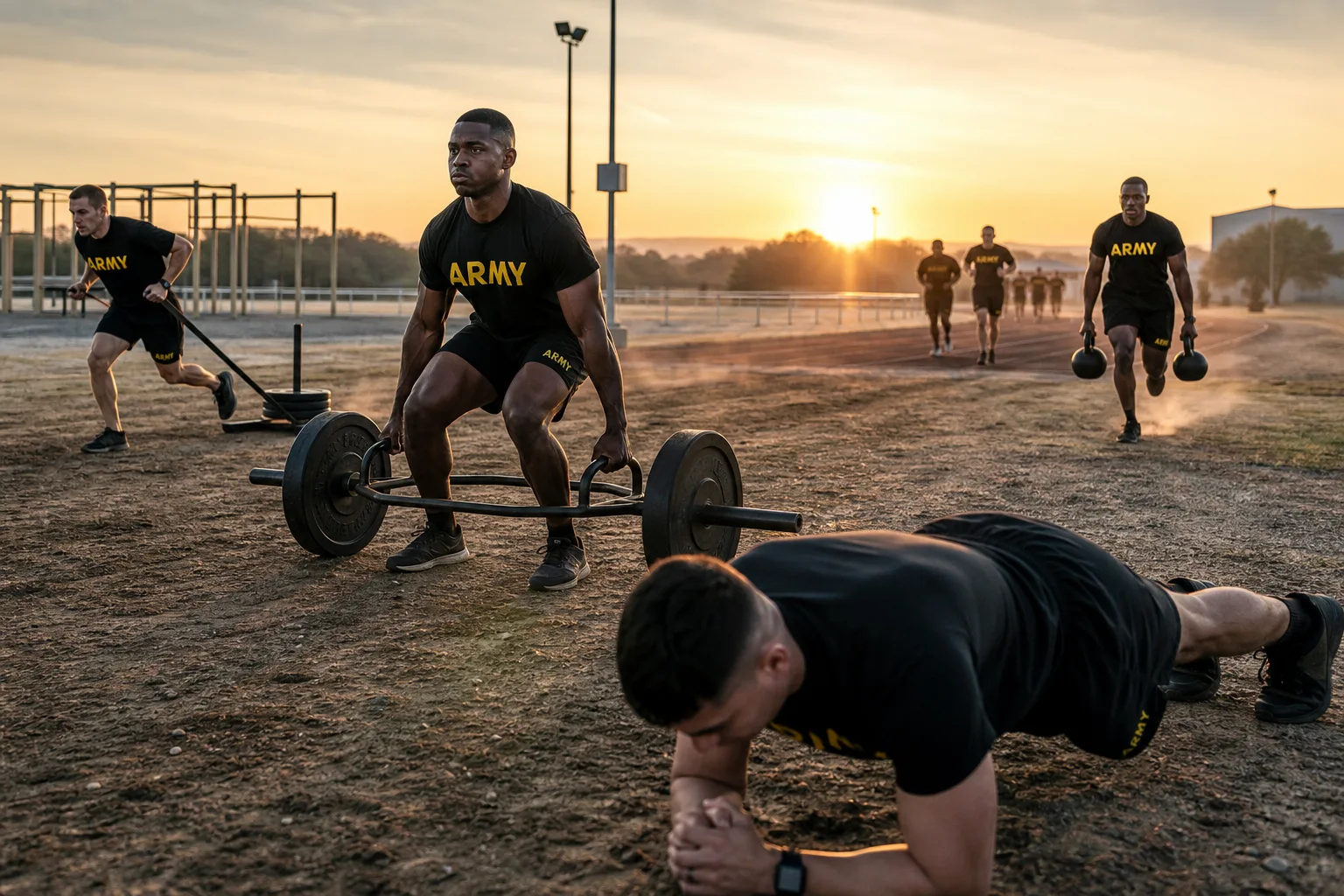
Last updated: 30 August 2026
Key takeaways
Train for the 2026 Army Fitness Test by rehearsing the five record events in test order, then scoring a diagnostic on the AFT calculator so you know which event is closest to a 60-point fail.
- The Army’s own AFT page sets the floors: 60 points per event, 300 total (general) or 350 total (combat specialties).
- Active-component record frequency is in Army Directive 2025-06 — plan recovery around those windows, not a random gym split.
- Event technique lives on this site’s five-event guides; this page is the weekly programming hub.
Start with a scored diagnostic
Train for the Army Fitness Test only after you know which event would fail you today. Enter a full five-event attempt in the interactive AFT calculator, then read the same raw marks against the AFT score chart for your age and sex scale. The official Army Fitness Test overview on army.mil/aft states that a Soldier must score at least 60 points in each event and that the general standard is a 300-point total while combat specialties require 350.
ATP 7-22.01 is the testing publication that prescribes DA Form 705-AFT. Confirm the current edition on the Army Publishing Directorate ATP 7-22.01 record before you treat a commercial gym movement as a substitute for a record event.
A four-day AFT training week
A practical AFT training week maps each day to a tested quality rather than a body-part split. Army Directive 2025-06 requires most Regular Army Soldiers to pass two record AFTs per calendar year with no less than four months between passing record tests — so the week has to leave a taper, not a peak-every-Friday grind. Read the frequency rules in Army Directive 2025-06 (PDF).
| Day | Primary quality | Record event it supports |
|---|---|---|
| 1 | Posterior-chain strength | 3-rep max deadlift (MDL) |
| 2 | Push-up volume + plank holds | HRP and plank |
| 3 | Shuttle power and carry | Sprint-Drag-Carry |
| 4 | Aerobic pace + easy recovery | Two-mile run |
Keep one easy day. Directive 2025-06 still ties record failures to a retest clock (90 days for the active population named in paragraph 4d). Training through a beat-up Achilles the week before a record test is how two-mile scores collapse.
- Score a diagnostic AFT and write the five event points, not just the total.
- Assign the weakest event to Day 1 or Day 3, whichever quality it uses.
- Rehearse official implements: hex bar, 90-lb sled, two 40-lb kettlebells.
- Taper two to three days before a record or diagnostic retest.
How to train each record event
The five-event battery on the Army Fitness Test page is three-repetition maximum deadlift, hand-release push-up, sprint-drag-carry, plank, and two-mile run. Train those movements, not a six-event ACFT memory. The Standing Power Throw is gone from the test of record.
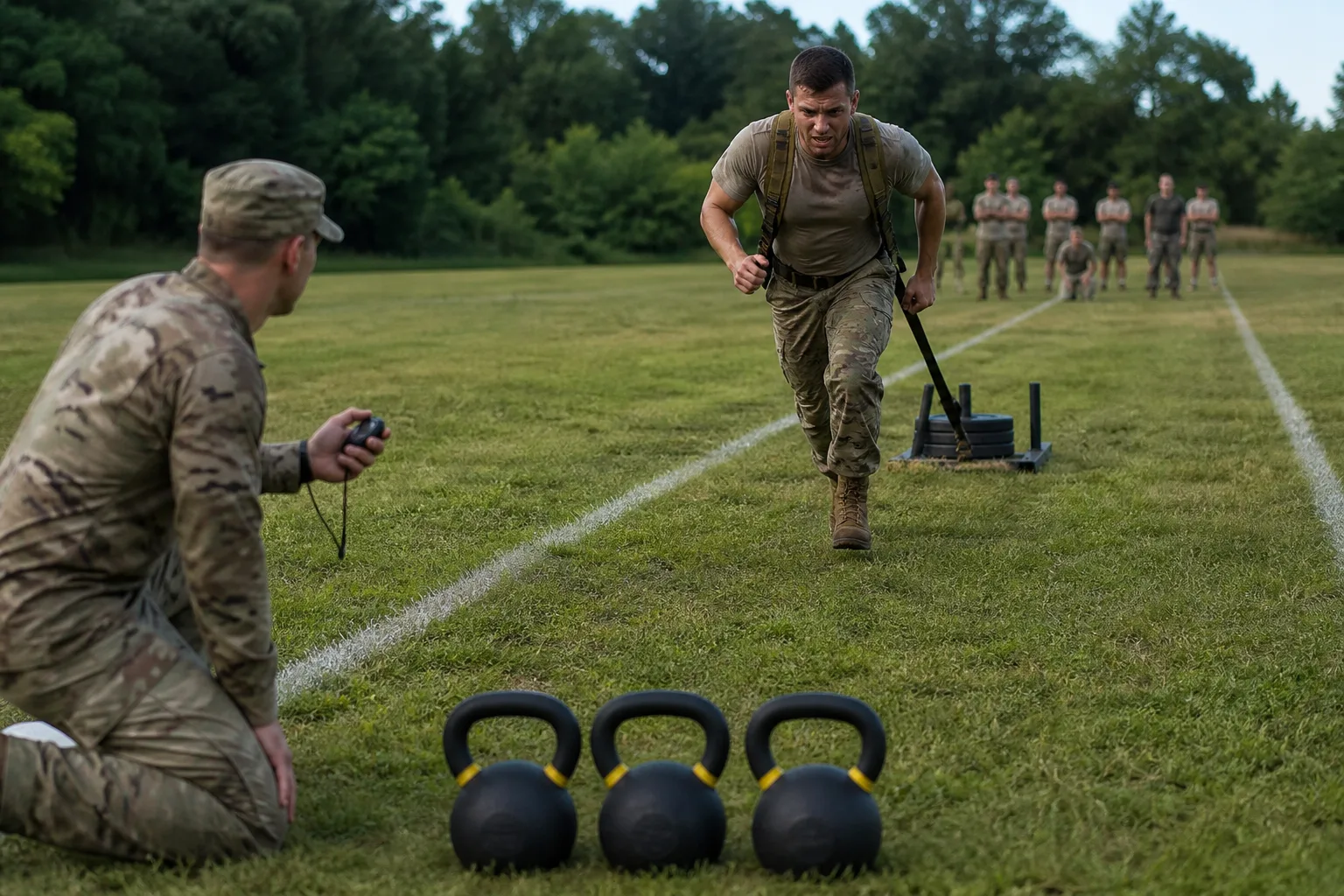
Deadlift and Sprint-Drag-Carry
Heavy hex-bar triples build the same posterior chain the sled drag uses. Pair them on separate days so the drag is not done on dead legs. Event standards and grader cues sit on the MDL guide and the SDC guide.
Hand-release push-up, plank, two-mile
HRP is a two-minute clock with a full hand lift. Plank is a continuous forearm hold. The two-mile is last, after the SDC has already taxed the legs — include at least one weekly run that starts slightly fatigued. Alternate aerobic events for profiles are listed on the alternate events calculator, not as a substitute for unprofiled Soldiers.
Combat 350 vs general 300 targets
Set the weekly point target from MOS, not from unit culture. The Army Fitness Test page describes a sex-neutral, age-normed combat standard of 350 total with 60 per event, and a sex- and age-normed general standard of 300 total with 60 per event. Confirm whether your specialty is on the combat standard MOS list before you train to 300 and call it done.
Soldiers chasing the AR 600-9 tape incentive should treat 80 points per event and a 465 total as a separate training goal. That exemption path is documented on the tape exemption hub and in the Army Body Composition regulation at AR 600-9 (PDF).
Print a working score sheet from the DA Form 705 generator when you run a full diagnostic so the training week uses the same five-event card a grader would.
FAQ
How should I train for the Army Fitness Test?
Train the five record events in the same order the Army tests them: hex-bar deadlift strength, hand-release push-up volume, Sprint-Drag-Carry shuttles, plank holds, and two-mile pace work. Score a diagnostic AFT first, then spend most sessions on the events that sit closest to the 60-point floor.
How many days per week should I train for the AFT?
Most Soldiers can cover the test with four to five training days per week if each session maps to a record event. Army Directive 2025-06 still requires two passing record AFTs per year for most active-duty Soldiers, so the training week has to leave recovery before a test window.
What is the fastest way to raise a failing AFT event?
Failing any event fails the test, even with a high total. Practice the exact tested movement (hex bar, hand-release, 90-lb sled, 40-lb kettlebells, forearm plank, two-mile course) rather than a gym substitute, then re-score that event on the AFT calculator.
Should combat MOS Soldiers train to 350 or 300?
Soldiers in designated combat specialties must meet the combat standard published on the Army Fitness Test page: at least 60 points in every event and 350 total. Combat-enabling specialties use the general 300-point total. Confirm your MOS on the combat-standard hub before you set weekly targets.